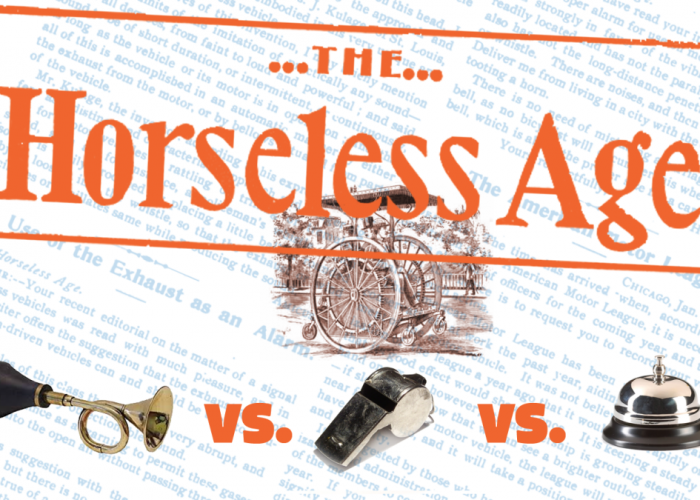
Hey, heres something fascinating just for all you crazy kids who have chosen to exist in the present: the past was also once a present, but for people who are now dead! G-g-ghost present! And back in that time they had ideas and opinions about cars, and those opinions and ideas and projects can be fascinating. I know this because Ive been poking around in some 1890’s issues of The Horseless Age, and Ive found some especially tasty nuggets to share with you, my best pals ever. So hang the fuck on.
The Horseless Age started in 1895, a response to the rise of motorized vehicles and the start of the transition from horsemeat-power to carmeat-power dominating the transportation landscape. The publication still exists today, though now its known as Automotive Industriesand is likely the oldest continually-published (or close enough) automotive publications.
Most of these snippets are from very early issues, mostly from 1896, so just keep in mind these are takes and ideas that are 124 years old. For perspective, the Civil War was as long before these things were written as the date the Nissan Pao I daily drive was built.
Bad Takes
As someone who writes a lot about cars, Im well aware that not all my takes are, you know, non-terrible. What heartening to realize is that automotive bad takes have a long, rich history. In fact, heres two takes that did not age well at all:
Look at that! Theres already scolds telling us were driving way too fast back in 1895, and theyre convinced that the insane speeds of 30 to 40 mile an hour is just part of a speed craze, and not conducive to safety. Just take a moment and imagine how cruelly satisfying it would be to get this guy into a time machine and take him for a spin on a modern highway at 75 mph.
Heres another take that, oddly, may be becoming relevant again today, sorta. The author here feels the term
…engine as applied to a source of power for road vehicles…is a mistake.
The author advocates that motor should be used exclusively, with engine saved for industrial and rail uses.
Of course, this guy did not get his way, as engine and motor are used pretty interchangeably these days, and have been for pretty much the whole century-plus of automobiles.
It may be relevant today because for electric cars, Id agree with him; a Tesla has an electric motor, not an electric engine, because electric powerplants are always called motors and never engines. So maybe thatll be enough for this verbal pedants ghost?
The Pre-Horn Debate
The horn is one of those things we absolutely take for granted in our cars. Its our very simplified voice through the car, a universal audible signal for attention, warning, alert, acknowledgement, greeting and more.
The idea that there was once a time where just what this auditory noise should be was undecided seems amazing to me, having always associated cars with horn-like sounds, either actual air-powered horns or electric horns. But that was by no means always the case whistles, bells, and more were considered:
Whats really interesting is how this decision seems to have been attempted to be sort of crowd-sourced to The Horseless Ages audience, much how well often pose a question to you, our readers, to give your opinions in the comments.
It looks like that readership had lots of ideas:
The author of The Noise Question references a noisemaking invention developed by a Joseph Kulage of St. Louis, mentioning that his noise-making apparatus is integrated into an automobile of his own design.
Its not really clear just what this thing sounded like, but it seems to have been powered by the vehicles exhaust or bellows, and could be faint or very loud. I have no idea what it may have sounded like, but I suspect it may have been absolutely bonkers, at least if the design of Kulages automobile is any reference:
Holy shit, that is not what I was expecting at all! Its um, a mid-wheel drive, mid-engine, surry-topped, six-wheeler? With back-to-back seating? Is it bi-directional? Oh, and it seems it used only foot controls for everything, steering, throttle, and your hands were free to pack your pipe or enjoy a sloppy hoagie or far-too-public wank or whatever.
This is a glorious reminder that back in 1896, absolutely nothing should be taken for granted when it comes to automobile design.
Theres another letter advocating for the use of engine-exhaust-based signaling noisemakers:
It would probably suffice as a warning to permit these gases to suddenly escape into the open air without passing through a muffler.
Some have met this suggestion with the argument that it would frighten horses, but there is no reason to suppose that this would be any more true of a series of exhaust puffs than of the squawk of a horn or the blast of a whistle.
So, this suggestion would be instead of horns, all cars had those buttons that skip the mufflers and give you nice, loud straight pipes. Theres a bunch of cars that use that today, but the point is more deliberately to scare horses (or whatever else is around) as opposed to an alert noise.
Then we have a vibrating bell proponent, who does not like horns, not one bit, sir, and points out helpfully that a vibrating bells sound
…is readily located and has not the paralyzing effect of a gong.
Yes, yes, gong-paralysis is the last thing we need on our streets. Bell-man also feels that a five inch bell…is the proper size for a carriage, in case you were wondering.
I have more good, wildly outdated stuff to share from The Horseless Age, so, you know, stay tuned.read more
Time To Enjoy Some Century-Old Bad Takes And Arguments About What Horns Should Be