In the brief interlude between the Democratic and Republican virtual national Conventions, another taped act of police violence reminded the country that the wounds created by the brutal murder of George Floyd are far from healed. On Sunday, August 23rd, in the small city of Kenosha, Wisconsin, a bystander captured a white police officer shooting Jacob Blake, a Black man, seven times in his back, at point-blank range, as Blake tried to return to his car after an altercation with the police. Inside of Blakes car were his three young children. Miraculously, Blake survived his wounds, though he remains hospitalized and paralyzed from the waist down.
When night fell that Sunday, Black Kenosha rose up. For three days, barging right into the center of the Republican National Convention, cars and buildings were set ablaze, and furious protests went through the night, in rage against racism, inequality, and police terror. Pleas for calm clashed with the cries of despair and anger. Such scenes have played out repeatedly over this long and hot summer. Kenosha is a Midwestern Rust Belt city, midway between Chicago and Milwaukee, two of the most segregated cities in the United States. Black life is hard in Kenosha: African-Americans are eleven per cent of the population but represent twenty per cent of those living below the poverty line. White people in Kenosha are twice as likely to have a college degree as their Black peers. For the past two years, nearby Milwaukee and Racine have been ranked the two worst cities in the United States for African-Americans.
As in cities across the country, the disproportionately high level of Black poverty in Kenosha draws the attention of the police. In 2018, the county sheriff, David Beth, described five young Black people who had been arrested for shoplifting as garbage people who were a cancer to our society. In a barrage of racist invective, Beth continued, You have to wash your hands with these people. Were allowing this group of society to ruin our children and our grandchildrens future. We have got to try our best to save the future of our communities in our state, in our country. He went on, Weve got to get a handle on these people. And maybe what weve got to do is build warehouses that after this generation is gone, and theyve perished in these buildings, we can turn them into something else.
This is the kind of raw racism that led to Jacob Blake, though paralyzed and in critical condition, being handcuffed to his hospital bed. (He was facing criminal charges.) Meanwhile, two days after Blakes shooting, a white seventeen-year-old, armed with an assault rifle, killed two people at a Kenosha demonstration and then calmly walked through a line of police and returned to his home in suburban Illinois, unscathed. (The shooter, Kyle Rittenhouse, was later arrested, and is awaiting extradition to Wisconsin on homicide and other charges.) In Kenosha, local law enforcement predictably overreacted to demonstrations, teargassing and arresting a multiracial crowd of protesters, but it fraternized with white militiamen, even after those armed civilians violated a citywide curfew. The actions of the police seemed to indicate that white vigilantism is welcome in its effort corral protests that it does not like.
These local ripples overlapped with the provocative distortions of the Republican National Convention. In the Bizarro World of the R.N.C., the coronavirus has miraculously disappeared; a new white, silent majority cowers in fear of the omnipotent Antifa; and cities are ruled by a motley crew of Democrats, looters, and criminals who are threatening to invade nearby suburbs and destroy their way of life. No one will soon forget the unhinged speech by Kimberly Guilfoyle, a Trump campaign fund-raiser and the girlfriend of Donald Trump, Jr., in which she insisted, of Democrats, They want to steal your liberty, your freedom, they want to control what you see and think and believe so that they can control how you live. They want to enslave you to the weak, dependent, liberal victim ideology to the point that you will not recognize this country or yourself.
The R.N.C. made sure to include the voices of Black people, but it was not to decry racism in our country or even to indulge in the illusion of unity. Instead, the former professional football players Herschel Walker and Jack Brewer sought to defend Trump against charges of racism, with Brewer making the absurd claim, I know what racism looks like, Ive seen it firsthand. And America, it has no resemblance to President Trump. The video of Blakes shooting and the Convention reflected vastly different realities in the United States. In one, wealthy white élites with a few Black friends ignore the pandemic and pine for the police to impose a brutal regime of law and order; in the other, nearly two hundred thousand people have lost their lives to COVID-19, fourteen million are jobless, an estimated twelve million have lost their health insurance, and twenty-nine million people reported in July that they didnt have enough to eat. For Black people, there is, too, the constant threat of racist police violence.
Serendipitously, it was a professional basketball coach who made an emotional link between these different views of the country. After the Los Angeles Clippers beat the Dallas Mavericks in a playoff game on Tuesday, August 25th, their coach, Doc Rivers, turned his midnight, postgame news conference into a bitter exposition of Trump and the R.N.C. All you hear is Donald Trump and all of them talking about fear, Rivers said. Were the ones getting killed. Were the ones getting shot. Were the ones denied to live in certain communities. With tears in his eyes, he continued, Its amazing why we keep loving this country, and this country does not love us back. But, in a flash of anger, he also pointed to the hypocrisy of police officers assaulting Black men but showing respect to armed white anti-coronavirus-lockdown protesters. Its funny. We protest. They send riot guards, Rivers said. They go up to Michigan with guns, and theyre spitting on cops, and nothing happens.
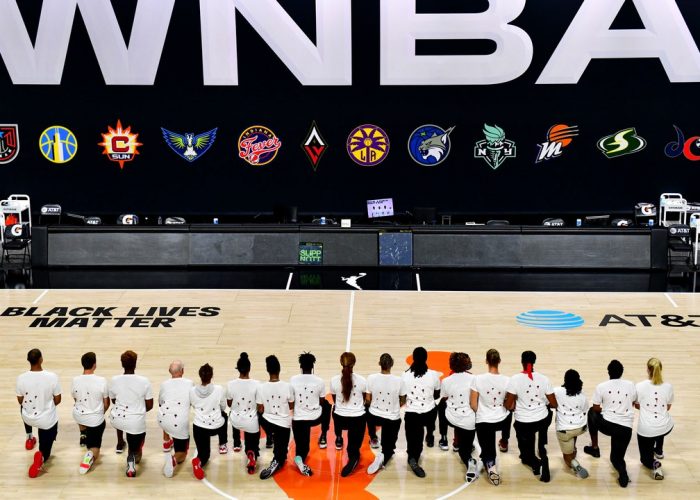
Riverss comments communicated the fear, frustration, and anger of most of Black America. The response was electric. The following morning, his words made headlines and dominated all of sports news. By late that afternoon, the Milwaukee Bucks, in the thick of the hunt for the N.B.A. championship title, refused to take the court to protest the police shooting in Kenosha. Within hours, the other teams in the playoffs also refused to play. In complete violation of their collective-bargaining agreement with the N.B.A., players engaged in a wildcat strike against racism and police violence. The radicalization of young Black professional athletes is a stunning development in this unfolding, raucous movement, one that demonstrates the sheer scale of racial inequality and a deep need to do something about it.
The N.B.A. is mostly a league of young Black men, who even as millionaire athletes are not immune to racist police harassment. Sterling Brown, a member of the Bucks, is only two years removed from having been brutally beaten by Milwaukee police. In January, 2018, Brown parked in a handicapped spot outside a Walgreens; instead of simply issuing him a parking citation, eight police officers beat Brown up, disparaged him, and tasered him before arresting him and taking him to jail. Within hours, he was released, with no charges filed against him. If this can happen to a millionaire Black athlete, what on earth happens to the young people that cops like David Beth think should be warehoused forever? This summer, Brown wrote about his case for The Players Tribune, describing how it catalyzed his involvement in Black Lives Matter. What Im fighting for is bigger than me, Brown said. Our fight for justice, equality, equity and respect will be heard and will be met. Our fight for our lives and freedom will no longer be up for debate! We will not be silenced!read more
The Players’ Revolt Against Racism, Inequality, and Police Terror