The delightful chutzpah of Radha Blanks first feature, The Forty-Year-Old Version (streaming on Netflix)which she wrote, directed, and stars instarts with the fact that she plays a character named Radha Blank, who, like the real-life person, is a playwright, mostly of unproduced plays, who seeks an alternative artistic outlet as a hip-hop artist. Radha (thats the character, as distinguished from the real-life Blank), a Black woman who lives in Harlem, was a young star of the theatre, the winner of a 30 Under 30 award, but now, months away from turning forty, has long been unable to get her plays produced. She works, without fulfillment, as a teacher of playwriting at a Harlem high school. She lives alone, with no romantic relationship anywhere in the vicinity, and she is mourning the loss of her mother, an artist, who died a year ago. She enjoys her hip-hop efforts, though they, too, prove fruitless. Then opportunity unexpectedly knocks: a nearly elderly white producer, J. Whitman (Reed Birney), agrees to produce her new play, Harlem Ave., about a young Black couple in Harlem who own a grocery store threatened by gentrificationbut he demands that she whiten it up and add elements which she considers poverty porn.
When a playwright writes and directs a movie, it should be no surprise that its teeming with dialogue, and that the actors are directed to deliver it with vigorous inflection. Those things are true of The Forty-Year-Old Version, but Blank has also accomplished something rarer, more precious, and more original: she has crafted an aesthetic that frames these voices and seemingly extrudes them from the screen in high relief. The imagesshot in black-and-white, often in long takes, often with piquantly oblique framings of the characters and with brisk camera moves linking different parts of the actionforeground the actors presence and ideas forcefully and distinctively. The movie is a treasure chest of voices, thanks not only to the dialogue but to the synergy of writing, acting, and visual composition. (The cinematographer is Eric Branco.)
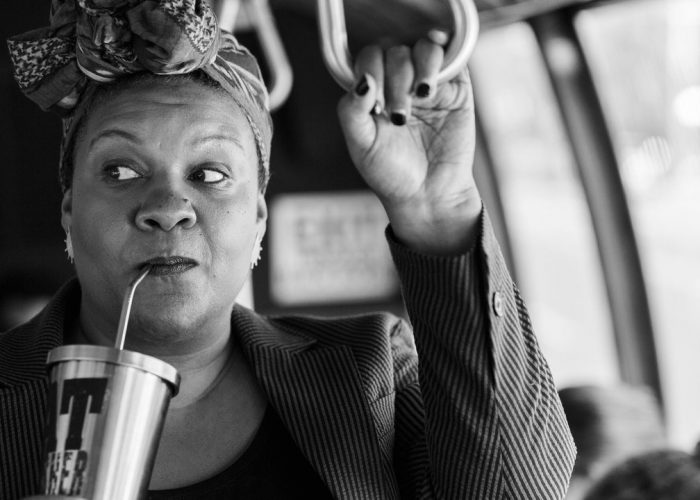
That sense of intimacy and proximity is all the more surprising inasmuch as The Forty-Year-Old Version is a comedy, and one that borrows from the conventions and the playbook of TV sketches, sitcoms, and Hollywood tradition. The movies artifices are conspicuous, and the positioning of Radhas character is familiarthe solitary urbanite whos a discerning observer of the city life that she loves even while she contends with its practical difficulties. But The Forty-Year-Old Version is a full-circle city satire in which Blank doesnt spare Radhaand in which the characters attitudes and antipathies dont take place in a void but, rather, snap back at her and make her feel their sting. With her loneliness, her frustration, and her self-conscious drift toward middle age, Radha has an edge of cantankerousness, but she finds it consistently challenged. She gets publicly shamed for her unseemly impatience during a commute to work, when the bus shes riding is delayed by the boarding of disabled passengers. She regards her students work with transparently toned-down disapproval, but when she tunes them out she loses control of the class. Her homeless neighbor, Lamont (Jacob Ming-Trent), calls her out for treating him with condescension. Radhas story is centered on self-consciousness, on conscience, and its mirrored in the bustling and jostling of her daily encounters and routines as much as in her major personal and artistic crises.
Blank fills the film with typesher main characters are introduced in caricatures that range from tender to sardonic, yet their prime traits, too, are those of consciousness and self-awareness (or the absurd lack thereof). Radhas manager, Archie Choi (Peter Kim), is a gay Korean-American man who has been her friend since high school. (She was his prom date when he was still in the closet.) Hes much more successful in the theatre world than she is, but he represents hervigorouslyas something of a special, unprofitable client on the basis of their friendship, which Radha sorely tests. When the two attend a cocktail party to meet Whitman, and the encounter proves disastrous, Radha finds all theatre doors definitively slammed shut in her face. So, picking up on her high-school passion and responding to a few coincidental signs and hints, she visits a young hip-hop producer, in Brooklyn, in the hope of finding a more direct outlet for her literary voice. That producer, named D, is played by Oswin Benjamin, in his first film role, and its one of the great recent acting débuts. Benjamin, who has an extraordinary vocal instrument, low and grainy and quietly urgent, also has a distinctive physical presence; he seems to fill the room even when just sitting still, and Blank perceptively deploys these qualities to define both Ds character and Radhas personal and creative relationship with him.
The comedic complications of Radhas hip-hop adventuresspoiler alert: shes not an overnight sensationnonetheless yield deeply moving, thrilling, fine-grained bursts of creative energy. Her first, uneasy effort in Ds apartment-studio, in Brownsville, turns out to be an extraordinary performance that impresses even the skeptical D. Theres a remarkable rap-battle scene featuring only female performers, to which D brings Radha and which Blank films with rapt admiration. Even more extraordinary is a scenethe morning after the pairs first night together, in Radhas apartmentin which D coaxes Radha and himself, both mourning their mothers, to commemorate them in improvised rhymes, which Blank films in a matched pair of images, one from afar, as the idea arises and coalesces, and another, closer and in shadows, of the two as they reach deep into themselves to give lyrical voice to their grief and their longing. Its one of the most moving fusions of image and performance in recent movies.
Throughout The Forty-Year-Old Version, Blank confronts the dramatists over-all problem of having her creative expression mediated by professional, administrative, financial, and social forcesand the particular problem of a Black artist whose career depends on white decision-makers. One of the key pivots of the movie involves Whitmans admonition to Radha that, in order for the white theatregoing audience to appreciate her play about white gentrifiers in Harlem, they need to see versions of themselves in it. Needless to say, the results of such mandated compromise dont turn out well. Yet in the very depiction of Whitman, and also of the obliviously racist white director he hires (played by Welker White), Blank mirrors, with a sly and sardonic wink, the very same maneuver, albeit without the sense of compromise. In dramatizing the efforts of a Black artist to present her experience honestly in a white-run media environment, the movie links the New York theatre scene with the world of movies in which Blank is working.
Blank punctuates the action with brief montages of New York voices, whether from Radhas neighbors or students, that come off not as mini-documentaries but as Radhas sharpened and crafted, character-like versions of the vibrant personalities who populate her daily lifeof the transmuting of experience into imagination, life into art. The Forty-Year-Old Version is the story of the forging of artistic consciousness, of having something to say and creating a persona with which to say it; of finding ways to convey reality by means of artifice in search of inner truthand confronting with practical wisdom the hostile environment in which that truth will be presented. The Forty-Year-Old Version is a self-aware movie on the subject of self-awareness, a quality that Blank anchors, conspicuously and self-revealingly, in pain, grief, humiliation, self-doubt, and struggle. Its the element of comedy that renders it endurableand enjoyable. That makes the entire movie its own happy ending.read more
“The Forty-Year-Old Version,” Reviewed: A Playwright’s Boldly Self-Aware Comedy of Art and Compromise