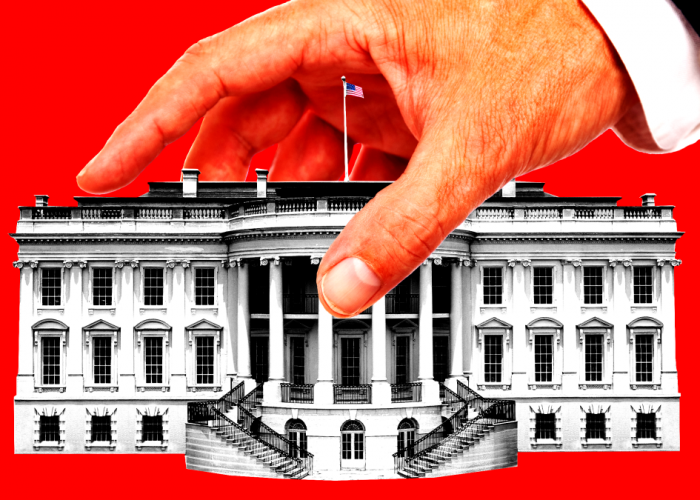
Not all governments or state institutions are immune to an overthrow of power. In November 2017, the people of Zimbabwe woke up to news that their countrys military had seized control of state media broadcasts and detained president Robert Mugabe, ushering in a new regime.
This forceful power-grab had all the hallmarks of a coup detat, defined by Merriam-Webster as the violent overthrow or alteration of an existing government by a small group. The Zimbabwean military, meanwhile, insisted that its forceful seizure of power was, in fact, not a coup.
And therein lies the key: Its rare that the architects of a coup will outright say that they are attempting one. Thats why its crucial to understand the subversive methods by which coups are often carried out, and how you can harness individual and collective power to resist them.
Coups thrive off a sense of public uncertainty
Every coordinated effort to overthrow an incumbent government needs a message, regardless of whether its based in fact. However, there are caveats: The side that appears to have popular momentum may attract more supporters, regardless of how much their message actually resonates with the body politic.
As Danny Orbach explained in a 2017 book review of Naunihal Singhs Seizing Power: The Strategic Logic of Military Coups:
Actors dont join the side they necessarily agree with, but the side they think most other actors are likely to support. Therefore, highly unpopular rebels may succeed, while popular rebels may fail.
Even if its not plainly obvious that a coup has been successfully staged, its key that the group stealing power spread a message of victory, usually by assuming control of a countrys broadcast channels.
As Orbach writes:
The conspirators do not need to waste time rumbling about their righteousness. Instead, they have to hammer home the idea that they have already won, that most important actors have already pledged their support for the coup. Even if untrue, such a broadcast may create a self-fulfilling prophecy.
Countries with weak public institutions are more susceptible
If a countrys institutions are strong and enjoy public support and respect, its highly unlikely that a coup attempt will take place, let alone succeed. Countries with fragile systems of government that may have been disrupted by war, corruption, or myriad other factors are more likely to succumb to a rogue groups efforts to topple them.
According to a 2016 paper published by the University of Hamburgs Institute of Law of Economics, coups flourish in the right environment:
Countries may be more vulnerable to coups, if they have weak political institutions and lack informal institutions that could support resistance against a regime that itself came to power by staging a coup. This is the case for countries that are non-democratic or have a low income per capita, countries that recently gained independence or experienced regime change, as well as countries with low levels of education.
Coups often try to dismantle democracy
The United States escapades in Latin America during the Cold War are a great example of how outside actors can spoil a fair and legal democratic process.
Take the 1973 CIA-backed coup in Chile, for example. Democratically elected Marxist Salvador Allende was violently ousted by forces led by General Agosto Pinochet, with an assist from then-president Richard Nixon and his Secretary of State Henry Kissinger. For a more recent example, Egypt descended into social chaos in 2013 when the countrys first democratically elected president, Mohammed Morsi, was ousted by the military a year after his election.
Of course, the particulars of every coup throughout history are different, but one prevailing theme has largely remained, especially when a democratically elected regime is ousted. As the University of Hamburg paper determined: Successful coups lead to both worse democratic institutions and greater violence.
How to prepare for and/or stop a coup
Keep in mind, theres no prescribed set of rules, and this isnt something that any individual can really accomplish on their own. But you should be prepared to take action in the streets.
The recent example of Turkey in 2016 shows how popular opposition can form a powerful front against an attempted coup. When a section of the Turkish military attempted to depose president Recep Tayyip Erdogan, resulting in the deaths of nearly 250 civilians after fighter jets bombed parliament and tanks descended on Ankara and Istanbul, scores of everyday civilians flooded the streets. The resistance of Turkish citizens, along with some allies in the military, foiled the coup in a matter of hours.
Short of those life-risking endeavors, its crucial that people who think there might be a coup afoot stay vigilant and watch out for some of the more subversive warning signs. On a tactical level, its smart to actively communicate with those around you. As Daniel Hunter writes for the non-profit Waging Nonviolence: Coups are not a time to just watch and wait until someone else figures it out. No matter who you are you can be a part of choosing democracy.
Hunter explains that point further, indicating some plans of action that go beyond your traditional march on Washington:
Its not about protest but about getting people to reassert core values like showing up at elected officials offices to get them to agree to honor election results. And its not about single points of actions like marches in D.C. but instead actions like mass strikes from youth and students refusing to go to work or school until all votes are counted. If you live in a country with decaying public institutions, fracturing trust in democracy, and powerful public figures who routinely flout traditional norms and deny reality, then it might be time to pay attention.
Moreover, laying the groundwork for resistance requires you know what resources are at your disposal. Theres tons of organizations dedicated to keeping the rule of law and democracy intact, and if push were ever to come to shove, itd be a no-brainer to get in touch. Though theres almost always local organizations in your state, city, or town, national organizations such as Indivisible, Our Revolution and Stand Up America are always ready to organize and tackle threats to democracy no matter your zip code.
These are general guidelines for anyone who lives in a country with decaying public institutions, fracturing trust in democracy, and powerful public figures who routinely flout traditional norms and deny reality. If that sounds eerily familiar, you may want to think ahead about how you would respond to the unfortunate phenomenon.read more
How to Identify and Fight a Coup